How To Search for Lansing Property Records
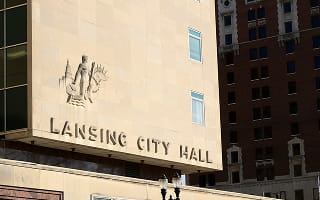
Always review property records before buying or investing in real estate in Lansing. These records offer a wealth of information that you can use to do your due diligence, from land ownership and tax assessments to legal filings, building permits, and other details that can help you make sound investment decisions. Lansing property records are public records, meaning that they are available to anyone who wishes to view or copy them. Because Lansing spans three counties (most of the city is in Ingham County, but portions extend into Eaton and Clinton Counties), knowing which office to contact is the key to a successful search. We have provided a list of resources below to help you find different types of Lansing property records.
County Register of Deeds

Lansing is spread across three counties: Ingham, Eaton, and Clinton. The Register of Deeds for each county serves as the official custodian for deeds, mortgages, land contracts, liens, and other documents related to property ownership and interests in Lansing. The registers of deeds offices provide search tools that you can use to access these records online. Searches can typically be done by name, address, date, or parcel number, though search criteria and available information may vary by county. Keep in mind that each office only maintains records for properties located within its own county boundaries. You can also visit the relevant register of deeds office for in-person services.
Here are the contact details and direct links to the online search tools for the Ingham, Eaton, and Clinton Counties Registers of Deeds Offices:
-
Ingham County Register of Deeds:
341 S. Jefferson Street, 2nd Floor
Mason, MI 48854
Phone: (517) 676-7216
Direct Search (free index-only searches)
Tapestry (fee per search)
Laredo (subscription-based)
*Appointment scheduling is recommended for in-person searches, particularly for older records.
-
Eaton County Register of Deeds:
1045 Independence Boulevard, 1st Floor
Charlotte, MI 48813
Phone: (517) 543-4203
-
Clinton County Clerk/Register of Deeds:
Suite 2500, 100 E State Street, St.
Johns, MI 48879
Phone: (989) 224-5270
Lansing Assessor's Office

The Lansing Assessor's Office is responsible for identifying and determining the value of real property in the city for tax purposes, making it a key resource for information on property sizes and boundaries, assessed values, sales history, and more. The office provides a property information lookup tool that can be used to search this information by name, address, or parcel number, with an advanced search option offering additional criteria. If you prefer in-person services, you can visit the assessor's office at 124 W Michigan Avenue, 3rd Floor, Lansing, MI 48933. You may also call (517) 483-7624 or email assessor@lansingmi.gov for inquiries and general assistance.
Lansing Treasury & Income Tax Office
The Lansing Treasury & Income Tax Office bills and collects property taxes for the city. The office provides access to an online tool that you can use to look up tax bills, payment histories, current balances, tax liens, and other property tax-related information by address, name, or parcel number. You can also visit the treasury and income tax office at 124 W Michigan Avenue, Lansing, MI 48933 for in-person services or call either 311 or (517) 483-4121 for general information and assistance.
Circuit and District Courts

You can find property records related to foreclosures, liens, land contract forfeitures, title disputes, civil judgments, and similar legal matters in Lansing through the 30th Judicial Circuit, 56th Circuit, 29th Judicial Circuit, and 54-A District Courts. The circuit courts handle larger civil disputes, boundary disagreements, title issues, and foreclosure cases in the city, with jurisdiction depending on the property's location, while the district court handles landlord/tenant matters and civil cases involving less than $25,000, regardless of location. Each court provides a search tool that you can use to look up records online by name or case number. You can also search and request copies of records in person at the relevant courthouse.
Here are the contact details and direct links to the case search tools for the circuit and district courts that serve the City of Lansing:
-
30th Judicial Circuit Court - Lansing Location (serves Ingham County):
Veterans Memorial Courthouse, 313 W Kalamazoo St., 1st Floor
Lansing, MI 48933
Phone: (517) 483-6500
-
56th Circuit Court (serves Eaton County):
1045 Independence Boulevard
Charlotte, MI 48813
Phone: (517) 543-4335
-
29th Judicial Circuit Court (serves Clinton County):
Suite 4500, 100 E. State Street, St.
Johns, MI 48879
Phone: (989) 224-5140
-
54-A District Court:
124 W Michigan Avenue
Lansing, MI 48933
Phone: (517) 483-4433
Lansing Property Taxes
Lansing property taxes are a crucial source of funding for essential public services, including public schools, law enforcement, fire protection, emergency response, and local infrastructure maintenance. The Lansing Assessor's Office is responsible for establishing the taxable value of all real property in the city, while the Lansing Treasury and Income Tax Office handles tax billing and collects payments.
Properties are evaluated every year to determine their "true cash value" and then assessed at 50% of that value. A property's taxable value is calculated by applying a state-mandated inflation cap to its previous year's assessed value. Local millage rates are then applied to this taxable value to determine the actual amount of the property tax bill. Under state law, annual increases to taxable values are capped at either 5% or the rate of inflation, provided there is no transfer of ownership. If this happens, the property's taxable value "uncaps" and resets to the assessed value (50% of its true cash value) in the following year.
Tax bills are typically issued in two installments: summer tax bills, which are mailed in July and due by August 31st, and winter tax bills, which are mailed by the first week of December and due by February 14th. Due dates are extended to the next business day if they fall on a weekend or holiday. Late payment fees begin accruing immediately after the due dates, and unpaid taxes are handed over to either the Ingham, Eaton, or Clinton County Treasurer for collection on March 1st. This leads to additional penalties and possible foreclosure on the property if the taxes remain unpaid. The Lansing Treasury & Income Tax Office provides several options for paying property taxes, including online, mail, ACH payments, and in-person transactions. You can call 311 or (517) 483-4121 for more information and general assistance.
![]() Assessments
Assessments

The Lansing Assessor's Office conducts annual assessments of properties in the city to determine each property's taxable value. These assessments involve gathering key information, such as land and building size, recent real estate sales in the area, and construction costs, and then applying mass appraisal techniques to estimate the property's true cash value (its fair market value). Properties are assessed at 50% of their true cash value, and the resulting assessed value is referred to as the property's "state-equalized value (SEV)".
However, taxes are actually based on the property's "taxable value". Michigan law limits annual increases to this value for continuous property owners by applying a state-mandated inflation cap (the lesser of 5% or the rate of inflation) to the property's taxable value from the preceding year. This means that each year, a property's tax bill can only increase by a limited amount regardless of market spikes, unless the property is sold. If a sale occurs, the property's taxable value will be "uncapped" and reset to its current SEV in the following year.
Assessment notices are typically mailed out in late February. If you believe that your property has been incorrectly assessed, you may file an appeal through the Lansing City Assessor and appear before the local Board of Review. The filing and hearing period is usually around mid-March, though exact dates vary each year. The assessor's office announces the specific schedule in advance and also provides instructions and options for submitting appeals during this window. If you are unsatisfied with the board's decision, you can escalate the issue to the Michigan Tax Tribunal. You may call the Lansing Assessor's Office at (517) 483-7624 for more information and general assistance.
![]() Appraisals
Appraisals

Lansing assessments work similarly to appraisals. They both determine the fair value of property by comparing similar properties with others in the local area that have sold recently. In cases of odd structures or new construction, the county may call upon an appraiser to help determine the value. Estate planners, courts, and lenders also use appraisals to value real property.
![]() Tax Rates
Tax Rates

Because Lansing is located in multiple counties, the city's median effective property tax rate varies. For properties in the Ingham County portion of Lansing, the rate is 2.26%, which is higher than both the national median of 1.02% and the Michigan state median of 1.07%. In contrast, properties in Eaton and Clinton Counties have median effective property tax rates of 1.01% and 0.76%, respectively, both lower than the national and state medians. The average annual property tax bill in Lansing also depends on the property's location within the city: $2,319 in Ingham County, $2,032 in Eaton County, and $1,605 in Clinton County, all of which fall below the national average of $2,400.
Here's how Lansing's tax rates compare to other counties in Michigan:
- Bay County 1.00%
- Calhoun County 1.36%
- Genesee County 0.93%
- Gogebic County 1.50%
- Kent County 0.89%
- Macomb County 1.19%
- Muskegon County 0.47%
- Oakland County 1.37%
- Ottawa County 0.90%
- Wayne County 1.44%
![]() Exemptions
Exemptions

Even though property tax bills in Lansing are relatively lower than the national average, some residents may still struggle to meet their annual tax obligations. Thankfully, there are several tax exemptions available to homeowners to help reduce their tax burden. These exemptions include:
-
Principal Residence Exemption (PRE): Available to anyone who owns and occupies a home in the city as their legal, primary residence and reduces their property's taxable value by exempting a portion of local school operating taxes (up to 18 mills).
-
Poverty Exemption: Available to homeowners who have a valid PRE on file and meet specific income and asset guidelines established by local ordinance.
-
Disabled Veterans Exemption: Available to honorably discharged veterans with a service-connected disability and their unremarried surviving spouses.
You can contact the Lansing Assessor's Office at (517) 483-7624 for inquiries on available exemptions and general assistance with applying for one.
Lansing Building Permits/Inspections
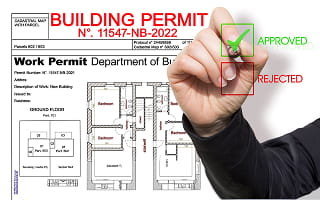
New construction and renovations, alterations, or repairs to existing properties in Lansing require permits. Minor repairs and cosmetic work (painting, flooring, etc.) are generally exempt, provided the work does not affect the building's structural supports, core systems, or safety features. The Lansing Building Safety Office manages the permitting process. You can use the city's BS&A Online platform to submit permit applications, pay fees, and schedule inspections. Note that you may need to create a user account to utilize the platform. If you prefer in-person services, you can visit the building safety office at Suite C-1, 316 N Capitol Avenue, Lansing, MI 48933. You may also call them at (517) 483-4355 for inquiries and general assistance.
Common types of permits issued in Lansing include:
-
Building Permits: Required for most construction projects, including new buildings, additions, and structural alterations or repairs.
-
Residential Building Permits: Issued for work involving one- and two-family dwellings (duplexes and single homes).
-
Commercial Building Permits: Issued for work involving all other types of property (commercial, industrial, and residential buildings with three or more units).
-
-
Demolition Permits: Required for tearing down structures, whether residential, commercial, or industrial.
-
Trade Permits: Required for any work that changes a building's systems.
-
Electrical Permits: Issued for work involving electrical systems.
-
Mechanical Permits: Issued for work involving mechanical systems.
-
Plumbing Permits: Issued for work involving plumbing systems.
-
When applying for any of these permits, you must submit the proper documentation (building plans, blueprints, contractor licenses, materials lists, etc.). You must also pay the appropriate fee.
Building inspections are part of the permit process, and they ensure that the work complies with local building and safety codes. You can schedule an inspection through the online portal or in person at the office during regular business hours.
Real Estate in the City of Lansing
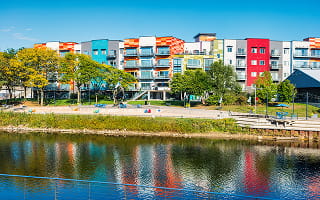
Nicknamed "The Heart of Michigan" for its central geographic location, Lansing has served as Michigan's capital city since 1847. Over time, the city has parlayed its position to become a regional hub for government, education, insurance and commerce, and it holds the distinction of being the only U.S. state capital that isn't also a county seat. Lansing is the birthplace of various notable figures, including John Hughes, Earvin "Magic" Johnson, and Steven Seagal, and features attractions such as the Impression 5 Science Center, the R.E. Olds Transportation Museum, the Lansing Art Gallery, and the historic Turner-Dodge House. It also hosts annual events like the Old Town BluesFest and the Lansing JazzFest, which draw tens of thousands of visitors.
Lansing, Michigan, has a population of 112,644 residents, with 54,614 housing units: roughly 92% of these units are occupied, and 53% are owner-occupied. The city offers a wide array of housing options, including single-family homes, apartments, condos, townhomes, duplexes, historic homes, and farmhouses. Common housing styles include Victorian, Queen Anne, Colonial Revival, Craftsman, Mid-Century, Ranch, Modern, and Contemporary. The average home price in Lansing, MI, is $157,629, reflecting a 4.4% increase over previous years. Note that home values can vary significantly depending on the neighborhood. Here are a few examples:
- Averill Woods $201,838
- Colonial Village $172,630
- Edgemont Park $192,327
- Genesee $126,959
- Lewton Rich $214,606
- Old Oakland $107,099
- Westside $149,211
The Lansing, Michigan, real estate market is a stable, moderately competitive market. While prices have risen over the years, the city remains more affordable than many other Michigan markets, making it attractive for buyers seeking value and for sellers looking for steady appreciation. Homes typically go under contract within about 21 days of listing, and roughly 36% of properties sell above the listing price.
Searching across multiple government offices and databases to piece together a complete property profile can be time-consuming, but PropertyChecker simplifies the process by pulling key ownership details, tax records, transaction histories, and more into a single, easy-to-use platform. Whether you are buying, investing, or simply doing your due diligence, visit PropertyChecker.com to get the property information you need in minutes.